Be yourself; Everyone else is already taken.
— Oscar Wilde.
This is the first post on my new blog. I’m just getting this new blog going, so stay tuned for more. Subscribe below to get notified when I post new updates.
Be yourself; Everyone else is already taken.
— Oscar Wilde.
This is the first post on my new blog. I’m just getting this new blog going, so stay tuned for more. Subscribe below to get notified when I post new updates.
Development Length Calculation as per Indian Code
Development length is the extra length of bar provided beyond the required section in order to ensure the following;
Importance: Provision of appropriate development is an important aspect of safe construction practices, proper development length in reinf. bars shall be provided as per the steel grade considered in design otherwise in scenarios where less development length against the required is provided the structures will be prone to encounter failure due to slippage of joints, bonds, anchors & Laps, in such cases the bars will not yield first but the failure will happen at joints & laps prior to yielding of reinforcement bars.
Calculation of Development length:As per the Indian Standard – IS 456: 2000, clause 26.2.1 the development length Ld is given the following expression;
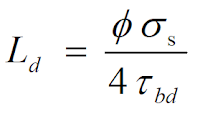
Where, Ø = nominal dia of reinforcement bar
σs= Stress in bar at the section considered at design load τbd = Design bond stressThe above given formula is used to calculate the required development length in mm for any given dia of bar, same formula is used for limit state method as well as working stress method. The only change in calculation in both methods is due to the different value of design bond stress; the values of design bond for Limit State & working stress are as follows;
This is an example post, originally published as part of Blogging University. Enroll in one of our ten programs, and start your blog right.
You’re going to publish a post today. Don’t worry about how your blog looks. Don’t worry if you haven’t given it a name yet, or you’re feeling overwhelmed. Just click the “New Post” button, and tell us why you’re here.
Why do this?
The post can be short or long, a personal intro to your life or a bloggy mission statement, a manifesto for the future or a simple outline of your the types of things you hope to publish.
To help you get started, here are a few questions:
You’re not locked into any of this; one of the wonderful things about blogs is how they constantly evolve as we learn, grow, and interact with one another — but it’s good to know where and why you started, and articulating your goals may just give you a few other post ideas.
Can’t think how to get started? Just write the first thing that pops into your head. Anne Lamott, author of a book on writing we love, says that you need to give yourself permission to write a “crappy first draft”. Anne makes a great point — just start writing, and worry about editing it later.
When you’re ready to publish, give your post three to five tags that describe your blog’s focus — writing, photography, fiction, parenting, food, cars, movies, sports, whatever. These tags will help others who care about your topics find you in the Reader. Make sure one of the tags is “zerotohero,” so other new bloggers can find you, too.
Have a WordPress.com account? Log in now.

